
Born Again

[This is a sermon for the Second Sunday in Lent, March 1, 2026. Churches without pastors, preachers short on time, Bible study leaders, and individuals, may use it as you wish. God bless you.]
John 3:1-17
”The law says, ‘Do this,’ and it is never done. Grace says, ‘Believe in this,’ and everything is already done.”
With these words, Martin Luther describes the two ways in which God speaks and interacts with us, and the entire human race.
First, God speaks His Law to condemn us in our sin.
God’s Law shows us that we are sinners who merit eternal condemnation for our sinful natures and sinful actions.
God’s Word says of us, “They have become filled with every kind of wickedness, evil, greed and depravity. They are full of envy, murder, strife, deceit and malice. They are gossips, slanderers, God-haters, insolent, arrogant and boastful; they invent ways of doing evil; they disobey their parents; they have no understanding, no fidelity, no love, no mercy. Although they know God’s righteous decree that those who do such things deserve death, they not only continue to do these very things but also approve of those who practice them.” (Romans 1:29-32)
Of course, we all know God’s Law. We’re to love God and neighbor, worship God alone, love God’s Word, do and think only good things about our parents, leaders, and neighbors, and build others up, not tear them down, and we’re not to take from others or covet their blessings. We do know God’s Law, His will for us.
But people like us and everyone else who has ever walked on this planet–except for one–could be taught God’s Law continuously from dawn to dusk every single day of our lives and still not do God’s Law. In His Law, God says, “Do this,” and because of who we are, it never gets done.
And that’s a problem because, as the apostle Paul reminds us in God’s Word, “...wrongdoers [literally, he says here, “unrighteous ones”] will not inherit the kingdom of God…” (1 Corinthians 6:9)
To be righteous means to keep God’s Law perfectly. And righteousness is the baseline requirement for having life with God, now and in eternity. Yet, when God tells us to obey His righteous Law, it never gets done.
What are we to do?
That was a question that occupied a man named Nicodemus a lot.
Nicodemus was a Pharisee in first-century Judea, living in the same era in which Jesus walked on the earth, though Nicodemus would have been much older than Jesus.
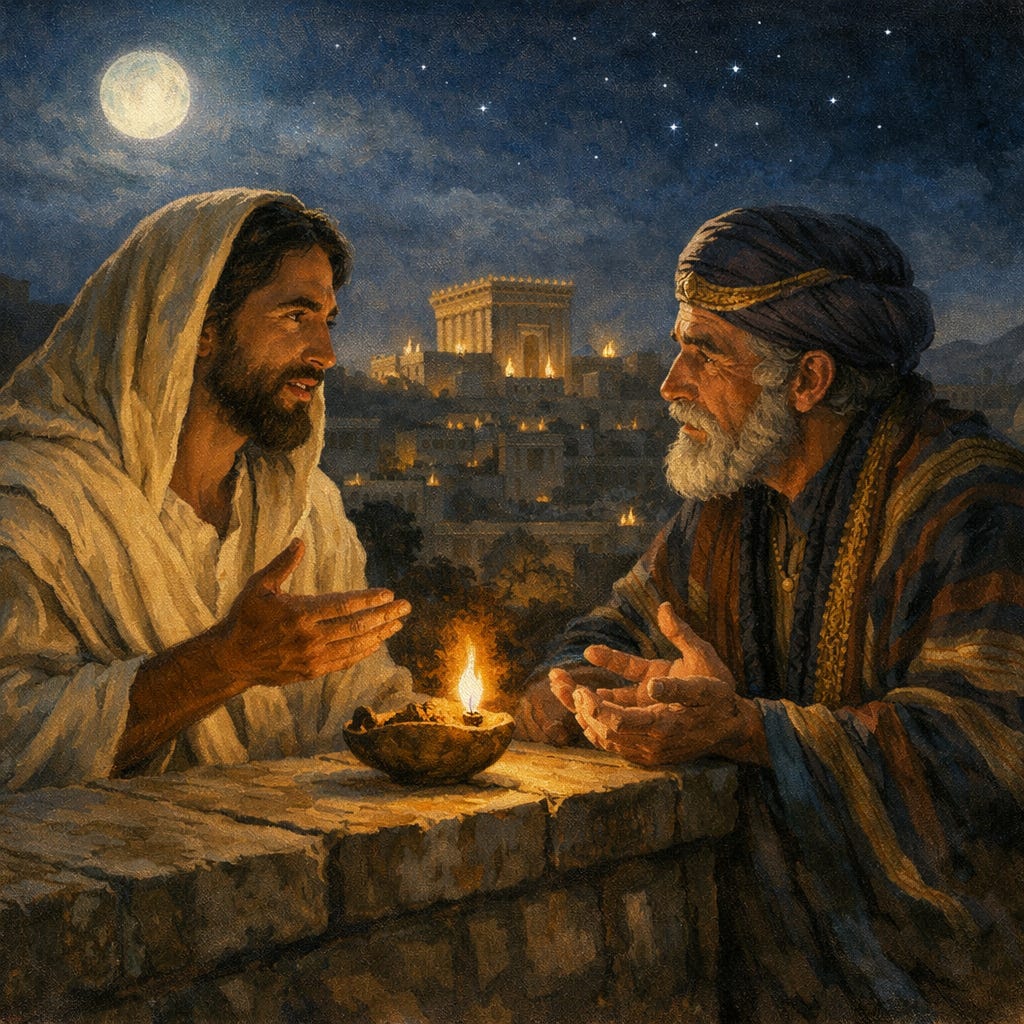
The Pharisee movement of which Nicodemus was a part lived under the misplaced confidence that they (and we) could behave with perfect righteousness, perfectly obey God’s Law, and so deserve life with God, including eternal life beyond the grave.
Part of the Pharisees’ misplaced confidence resided in how they twisted God’s Law. Jesus once condemned them, for example, for teaching that people could get around God’s command to honor their parents by telling their parents that whatever money they would otherwise spend on their parents in their old age, they would instead spend on God. No wonder Jesus told the Pharisees, “You leave the commandment of God and hold to the tradition of men.” (Mark 7:8-13) (Human traditions are often contrary to the will of God, by the way.)
The Pharisees, including Nicodemus, grew up believing that righteousness was about what human beings do. But they also gave themselves little escape clauses, human-created fine print to God’s Law meant to cover and deny the stench of human sin with the perfume of fake obedience.
When a Pharisee asked about God’s Law, “What are we to do?” they were really asking, “What is the bare minimum we can get away with doing and still be considered righteous?” When they hit the low threshold of their preferred version of righteousness, they let all the world know how good they were!
Nicodemus, with his confidence in his own righteous capacity to obey God’s Law was, in some ways, no closer to God than the modern-day atheist who thinks he can be a good person.
Anyone who thinks they can rise above their sinful nature or, if they’re inclined to believe in God, make themselves acceptable to heaven by their own goodness, is deluding themselves.
I believe this was beginning to dawn on Nicodemus when he visited Jesus that night. He’d been living in darkness. In Jesus, he began to see a sliver of the One the Bible calls “The true light that gives light to everyone…” (John 1:9). Because of Jesus, Nicodemus was starting to see that the Law had not and never could make him righteous.
And so, this member of the Sanhedrin goes to see Jesus. But soon, the teacher of the Law becomes the student of the One he already calls rabbi, meaning teacher. Jesus tells Nicodemus, “Very truly I tell you, no one can see the kingdom of God unless they are born again.” (John 3:3)
Now, Nicodemus should have heard these words of Jesus as the second of the two ways God speaks and interacts with us.
Nicodemus should have heard that God saves us from sin, death, and darkness not by the things we do, but by what God does for us. He should have heard the Gospel.
Here, Jesus is telling Nicodemus, “There is a way to righteousness–to acceptability to God–that has nothing to do with rules or laws.”
It’s about being born again–or born from above. (The phrase Jesus used can be translated either way.)
The image of birth that Jesus uses should, in itself, tell Nicodemus that being ‘born again” has nothing to do with what we do or what we decide.
Being right with God is nothing like what a high school classmate of mine described to me decades ago when she said, “I decided to be born again.” Now, that’s a silly statement on the face of it, when you consider it!
When they are born is not a decision made by children. We are all born when we are born. We have zero control over our conception or our moments of birth!
Just so, we are born again when God’s Word comes to claim us, and it’s only by the power of that Word that we come to saving faith in Jesus Christ.
Nicodemus hears Jesus’ words and wonders what he can do, what he must do, to be born again, as though he could be both the baby and the obstetrician at his rebirth.
Nicodemus wants Jesus to give him a guidebook so that he can get busy obeying a new law. “How can someone be born when they are old?” he asks. (John 3:4)
Jesus clarifies matters for Nicodemus.
Referencing Holy Baptism, the Christian sacrament that infants and children have undergone since the first Christian Pentecost ten days after the crucified and risen Jesus ascended into heaven, Jesus says, “...no one can enter the kingdom of God unless they are born of water and the Spirit.” (John 3:5)
Baptism, the apostle Paul tells us elsewhere, is, in one way, like circumcision, the rite every eight-day-old Jewish boy underwent to initiate his life with God. Our lives with Christ are meant to be initiated in Baptism.
But even if, as sometimes happens, because our God is a big God out to free all of us from the condemnation of sin and death, God’s grace comes to us before we’re baptized, we’re still not saved by what we do or what we decide. Our salvation is still not our doing!
We apprehend Christ’s victory over sin and death for us by faith. BY FAITH! And even our faith is His gift to us, not our decision! It’s all God’s work, 100% of it!
As Paul tells us in Ephesians: “For it is by grace you have been saved, through faith—and this is not from yourselves, it is the gift of God—not by works, so that no one can boast.” (Ephesians 2:8)
Our call from day to day is to turn, in trust, away from our sin, including our sinful reliance on our own goodness or good deeds, and turn to Christ Who died and rose to shield us in His righteousness.
Jesus’ words to Nicodemus are His words to you again today: “For God so loved the world that he gave his one and only Son, that whoever believes in him shall not perish but have eternal life. For God did not send his Son into the world to condemn the world, but to save the world through him.” (John 3:16-17)
“The law says, ‘Do this,’ and it is never done. Grace says, ‘Believe in this,’ and everything is already done.”
God’s Law condemns us.
But God’s Gospel saves us.
Friends, you can trust in what Christ has already done for you to make you forgiven, righteous, fit for life with God, now and forever. That’s the Gospel truth.
Through this Gospel and the means of grace by which it has been delivered to you–in the Word, in Holy Baptism, in Holy Communion, He gives you saving faith in Jesus and renews your faith in Jesus.
And it is faith in Jesus, not anything you do or don’t do, that brings you forgiveness and everlasting life with God.
That’s what Jesus’ Word tells Nicodemus–and you–today.
You can face your life each day in this world, and you can face your own death, resurrection, and eternity, knowing that Jesus, your Savior, has done everything for you that you can’t do for yourself. Jesus obeyed the Law you and I cannot obey, and Jesus gives you the Gospel so that you have life with God now and in eternity.
This is God’s saving Word for you.
Amen